
AI and Economic Development: What Chamber Leaders Need to Know
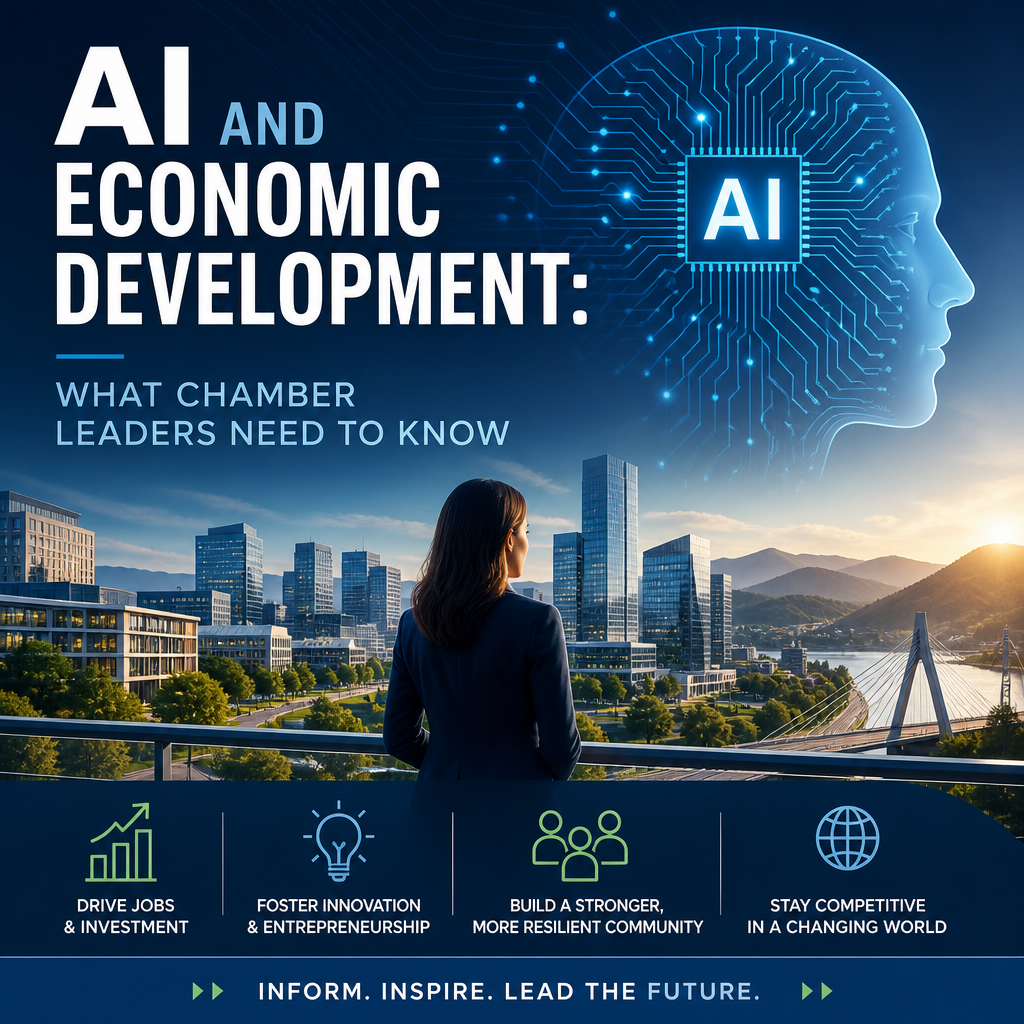
AI and Economic Development: What Chamber Leaders Need to Know
Artificial intelligence is already changing how businesses operate, compete, and serve customers. For chambers of commerce, the question is no longer whether AI will affect the local economy, but how communities can prepare to benefit from it.
AI and economic development intersect in practical ways: helping employers increase productivity, creating demand for new skills, attracting investment, and reshaping established industries. Chamber leaders can help businesses navigate these changes while ensuring that growth is inclusive and grounded in local needs.
Why AI Matters to Local Economies
AI tools can analyze information, automate routine tasks, generate content, support customer service, and assist with decisions. Used thoughtfully, they can help small businesses do more with limited staff and resources.
For example, a local retailer might use AI to forecast inventory, while a manufacturer could apply it to identify equipment maintenance needs. Professional service firms may use AI to summarize documents or streamline administrative work. These improvements can free employees to focus on higher-value tasks and help businesses compete beyond their immediate markets.
The economic impact will vary by industry and community. Regions with strong manufacturing, health care, agriculture, logistics, or technology sectors may find distinct opportunities. Understanding the local business mix is an important first step in identifying where AI can have the greatest effect.
The Chamber’s Role: Connector, Educator, Advocate
Chambers do not need to become technology providers. Their strength is bringing people together and helping businesses access useful information, expertise, and relationships.
Help Businesses Build Practical AI Literacy
Many employers are curious about AI but unsure where to begin. Chambers can host introductory workshops, peer discussions, or demonstrations focused on real business tasks—not technology hype.
Useful questions include:
- Which repetitive tasks consume valuable staff time?
- What information would an AI tool need to handle those tasks?
- How will employees review the tool’s output?
- What privacy, security, or accuracy risks should be addressed?
Encouraging small, low-risk experiments can help business owners learn what works before making larger investments.
Connect Employers With Training
AI may change job responsibilities even when it does not eliminate entire roles. Workers may need to learn how to use new tools, evaluate AI-generated information, and apply sound judgment alongside automation.
Chambers can convene employers, community colleges, universities, workforce boards, and training providers to identify emerging skill needs. These conversations can inform short courses, apprenticeships, and employer-led training. They can also help ensure that programs serve small businesses, workers in transition, and people who might otherwise be left out of new opportunities.
Support Responsible Adoption
AI systems can produce inaccurate results, expose sensitive information, or reflect bias in their underlying data. Businesses need clear practices for choosing tools and using them responsibly.
A chamber can share general guidance without endorsing a particular product. Encourage members to review vendor privacy terms, limit access to confidential data, verify important outputs, and keep humans accountable for consequential decisions. Responsible adoption is not only a technical concern; it is essential to maintaining customer and employee trust.
Make AI Part of a Broader Economic Strategy
AI should complement, not replace, the fundamentals of economic development. Businesses still need reliable infrastructure, access to capital, a skilled workforce, and a supportive environment for innovation. Communities also need to consider whether residents have access to digital tools and training.
Chamber leaders can incorporate AI into existing initiatives by asking:
- Which local industries could gain the most from AI?
- What barriers prevent small and mid-sized businesses from adopting it?
- Which workforce skills are becoming more important?
- How can local education and training partners respond?
- What safeguards will help ensure benefits reach a broad range of businesses and workers?
These questions can guide conversations with elected officials, employers, educators, and community organizations.
Measure Progress Beyond Headlines
AI investment announcements can attract attention, but they do not tell the whole story. Chambers should look for evidence of practical economic value: improved productivity, new business services, stronger workforce skills, better job quality, and greater resilience among local employers.
The goal is not to adopt AI everywhere or to chase every new tool. It is to help local businesses make informed choices and build capabilities that support long-term growth.
AI and economic development will look different in every community. Chamber leaders can shape that future by listening to employers, strengthening workforce partnerships, promoting responsible use, and making sure smaller businesses have a seat at the table.