
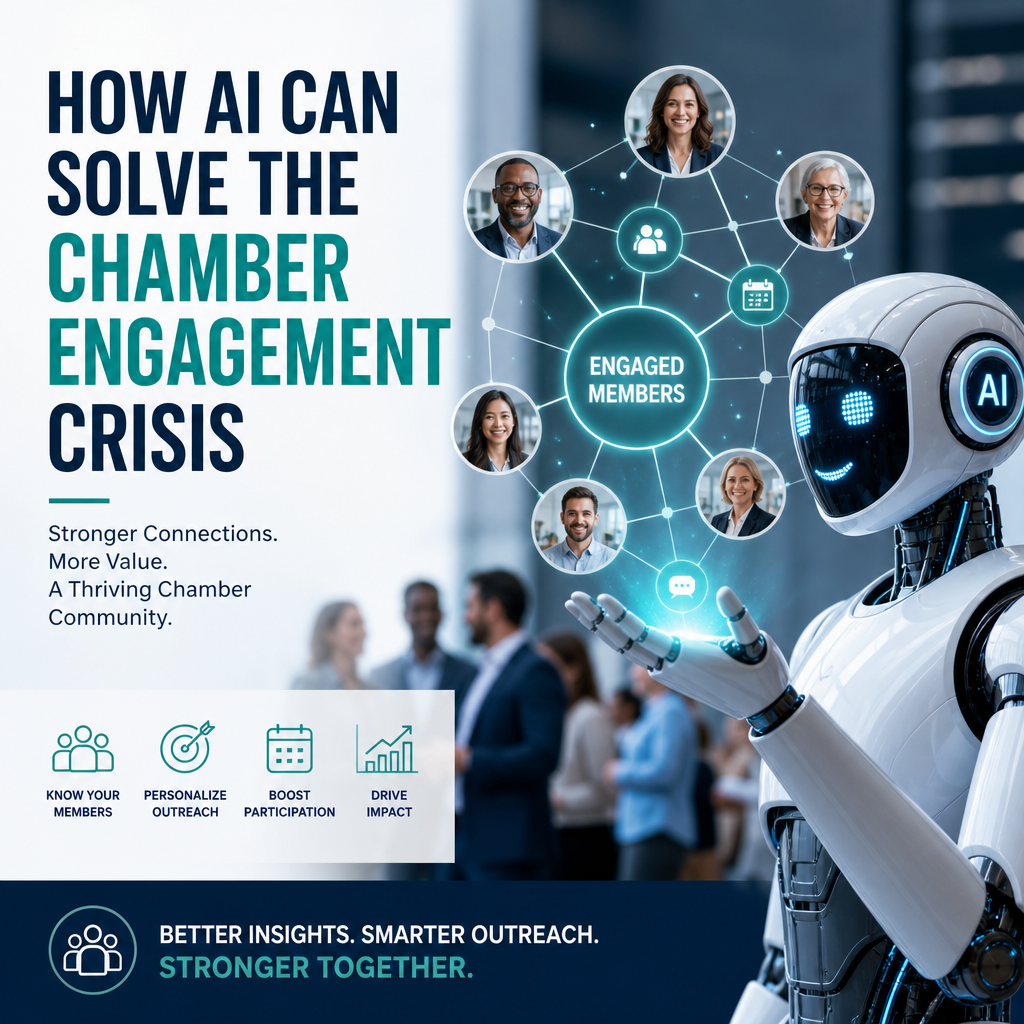
How AI Can Solve the Chamber Engagement Crisis
The Chamber Engagement Crisis: How AI Solves It
Chambers of commerce bring businesses together, advocate for local priorities, and help communities grow. Yet many face a persistent challenge: members sign up, attend a few events, and then drift away. Staff may be working hard, but limited time and scattered information make it difficult to deliver the right value to every member.
This is the chamber engagement crisis. Artificial intelligence (AI) can help address it—not by replacing personal relationships, but by giving chamber teams better ways to understand members, communicate consistently, and focus their time where it matters most.
Why Member Engagement Is So Difficult
Chamber teams often serve businesses with different needs, schedules, and goals. A new entrepreneur may want mentoring, while an established company may be looking for policy updates or hiring support. A single newsletter or event calendar cannot be equally relevant to everyone.
At the same time, engagement data is often spread across membership systems, email platforms, event registrations, surveys, and staff notes. Without a clear view of that information, it is hard to know who is participating, who may be losing interest, or what kind of support could make a difference.
Small teams face an additional obstacle: they simply do not have enough hours to research every member, personalize every message, and follow up after every interaction. The result can be communication that feels generic and relationships that depend too heavily on individual staff capacity.
How AI Helps Chambers Engage Members
AI tools can analyze information, recognize patterns, and support routine communication. Used thoughtfully, they help chambers make engagement more relevant and manageable.
Personalizing Communication
AI can help organize members into useful groups based on factors such as industry, business size, location, interests, or event participation. Staff can then tailor messages to those groups instead of sending every update to the entire membership.
For example, a chamber could share workforce resources with employers, startup programs with newer businesses, and export guidance with companies exploring international markets. Personalization does not need to mean creating a separate message for every member. Even a few well-chosen segments can make communications feel more useful.
Spotting Members Who May Need Attention
Engagement signals can include event attendance, email interaction, committee involvement, website activity, and renewal history. AI can help surface changes in these patterns—for instance, a long-standing member who has stopped attending events or a new member who has not connected with any programs.
These signals should be treated as prompts for human follow-up, not definitive judgments. A staff member might reach out with a personal check-in, ask what the business needs, and suggest a relevant connection. That kind of timely contact can prevent a quiet disengagement from becoming a cancellation.
Making Events More Relevant
AI can support event planning by reviewing past attendance, survey responses, and member interests. It may reveal that a particular audience responds well to short morning briefings, practical workshops, or small-group networking.
It can also help with event descriptions, promotional drafts, attendee summaries, and post-event follow-up. Staff still decide which ideas fit the chamber’s mission, but AI can reduce the time spent on administrative work.
Giving Staff Time Back
Routine tasks—drafting a first version of an email, summarizing survey results, organizing feedback, or answering common questions—can consume valuable staff hours. AI can speed up these tasks, leaving more time for conversations, partnerships, and member support.
That distinction matters: the goal is not to automate relationships. It is to remove some of the repetitive work that makes relationship-building difficult.
Using AI Responsibly
AI is most effective when it supports a clear engagement strategy. Chambers should start with a specific problem, such as low event participation or inconsistent onboarding, and test a tool against that need.
A responsible approach includes:
- Protecting member data: Use reputable tools, limit access, and avoid entering sensitive information into systems that are not approved for it.
- Checking AI-generated content: Review facts, tone, and recommendations before sending or acting on them.
- Keeping people involved: Let staff make decisions about member relationships and use AI insights as guidance.
- Measuring results: Track practical outcomes such as event participation, response rates, retention, and member satisfaction.
A More Connected Chamber
The chamber engagement crisis is not simply a technology problem. Members still value trust, useful connections, and personal attention. AI cannot create those relationships on its own, but it can help chambers deliver them more consistently.
By combining better data insights with thoughtful human outreach, chambers can recognize member needs sooner, offer more relevant opportunities, and make limited staff time go further. The result is not a colder, more automated organization. It is a chamber better equipped to help every member feel connected and valued.