

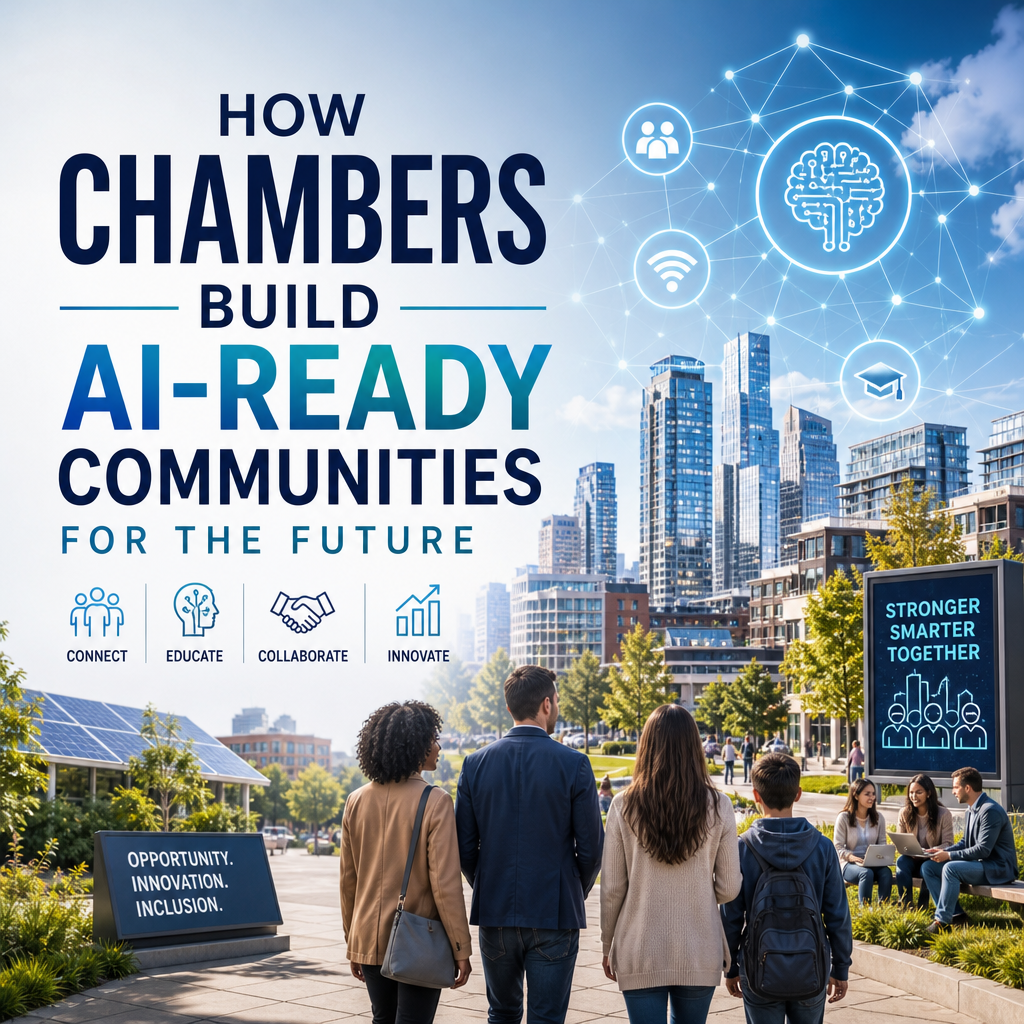
How Chambers Build AI-Ready Communities for the Future
The Role of Chambers in Building AI-Ready Communities
Artificial intelligence is changing how businesses serve customers, manage information, and make decisions. Yet adopting AI successfully takes more than access to new tools. Communities also need people who understand the technology, clear guidance on responsible use, and opportunities for organizations to learn from one another.
Chambers of commerce are well placed to help bring these pieces together. As connectors among businesses, educators, local government, and community organizations, they can make AI adoption more practical, inclusive, and responsive to local needs.
What Makes a Community AI-Ready?
An AI-ready community is not one in which every organization uses the latest software. It is one that can assess AI opportunities thoughtfully and respond to the risks.
That readiness includes several foundations:
- Digital skills: Workers and business owners can use AI tools and evaluate their results.
- Reliable infrastructure: Organizations have the connectivity, devices, and technical support needed to participate.
- Responsible practices: People understand issues such as privacy, accuracy, bias, and intellectual property.
- Access to guidance: Smaller organizations can find trusted information without needing a large technology budget.
- Local collaboration: Businesses, educators, and public institutions share knowledge and coordinate efforts.
Without these foundations, AI adoption can deepen existing gaps. Businesses with more resources may move ahead, while smaller employers and underserved communities struggle to keep pace.
How Chambers Can Support AI Readiness
Make AI Knowledge Accessible
Chambers can organize introductory workshops that explain AI in plain language. Rather than focusing only on technical details, sessions can demonstrate how tools may help with everyday tasks, such as drafting customer communications, summarizing documents, or analyzing routine data.
Practical examples help business owners see where AI might be useful—and where human judgment remains essential. Chambers can also share reputable learning resources and connect members with local experts, colleges, or workforce development programs.
Help Small Businesses Explore Adoption
Small businesses often lack dedicated technology teams. They may be interested in AI but unsure which tools are appropriate, what they cost, or how to protect customer information.
A chamber can help members ask the right questions before adopting a tool:
- What specific business problem should it solve?
- What data will the tool receive, and how will that data be handled?
- How will staff check the accuracy of its output?
- What are the ongoing costs, including training and oversight?
- Is there a way to test the tool on a small scale first?
This kind of support encourages measured experimentation rather than rushed adoption. It also helps businesses distinguish practical applications from products that promise more than they can deliver.
Build Connections Between Employers and Educators
AI is changing workplace tasks, which makes ongoing learning increasingly important. Chambers can bring employers together with schools, colleges, and training providers to identify emerging skill needs.
These partnerships can inform workshops, internships, career programs, and short courses. Employers can explain the capabilities they need, while educators can help develop accessible pathways for students and workers to build them. The goal is not simply to train people to use particular software, but to strengthen adaptable skills such as critical thinking, communication, data literacy, and problem-solving.
Encourage Responsible Use
AI tools can produce inaccurate, biased, or incomplete results. They may also create privacy and security concerns if users share sensitive information carelessly. Chambers can help make responsible use part of the local conversation from the beginning.
That means sharing clear guidance on human review, data protection, transparency, and appropriate limits. A business might use AI to create an initial draft, for example, while ensuring a knowledgeable employee checks facts, tone, and compliance before anything reaches a customer.
Chambers can also provide spaces where members discuss real experiences, including what did not work. Honest peer learning helps organizations make better decisions and reduces pressure to adopt AI simply because others appear to be doing so.
Keep Inclusion at the Center
An AI-ready community should create opportunities for people and organizations across the local economy. Chambers can listen to businesses of different sizes and sectors, including those that may have limited technology access or fewer staff resources.
They can also work with community groups to identify barriers to participation, such as cost, accessibility, language, or limited digital skills. Addressing these barriers helps ensure that the benefits of AI are not confined to a small number of well-resourced organizations.
A Practical Role for Local Leadership
Chambers do not need to become AI developers or technical authorities. Their distinctive contribution is to convene people, share trustworthy information, and help local organizations learn together.
By connecting businesses with educators, experts, and public partners, chambers can turn uncertainty into informed action. That steady, community-focused work is what helps a region become genuinely AI-ready: not by adopting every new tool, but by building the skills, relationships, and responsible practices needed to use technology well.


