

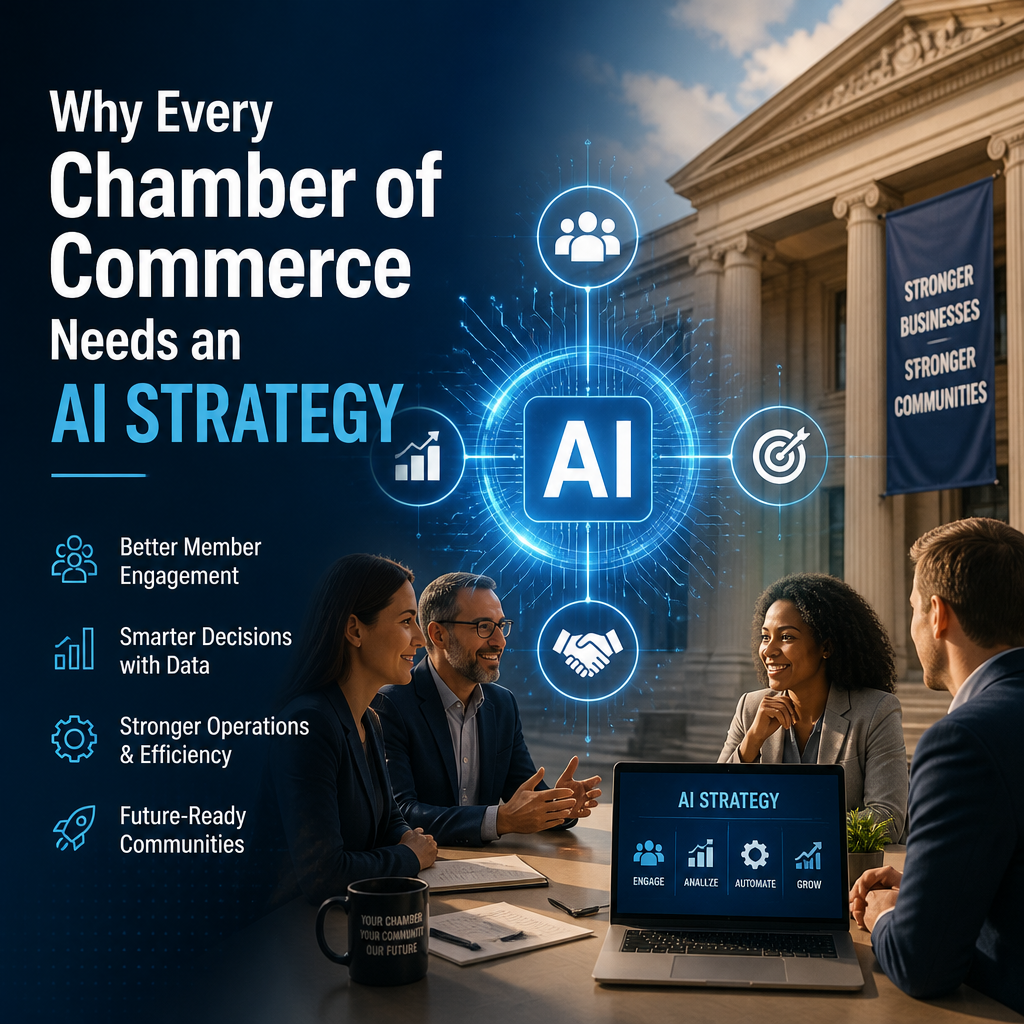
Why Every Chamber of Commerce Needs an AI Strategy
Why Every Chamber of Commerce Needs an AI Strategy
Artificial intelligence is changing how businesses communicate, make decisions, and serve customers. For chambers of commerce, the shift is especially important: members look to these organizations for practical guidance, trusted connections, and support through economic change.
An AI strategy helps a chamber respond to that need with purpose. It does not have to involve expensive technology or a large technical team. It starts with clear goals, responsible use, and a plan to help both the organization and its members adapt.
AI Is Becoming a Business Necessity
Businesses of every size are exploring AI tools to draft content, analyze information, automate routine tasks, and improve customer service. Some are already seeing time savings, while others are unsure where to begin or concerned about privacy, accuracy, and cost.
Chambers can help close that knowledge gap. By learning how AI works and where it can be useful, a chamber can offer members balanced, relevant guidance rather than leaving them to sort through hype and conflicting advice on their own.
This role is particularly valuable for small businesses. They may lack the staff or budget to test new tools, yet they still face pressure to work efficiently and keep pace with competitors. A chamber can make AI more accessible through workshops, peer discussions, and trusted resources.
An AI Strategy Improves Chamber Operations
AI can also help chambers deliver services more efficiently. Staff often handle recurring tasks such as answering common questions, preparing event communications, summarizing research, and organizing member feedback. With appropriate oversight, AI tools can assist with these tasks and free employees to focus on relationships and higher-value work.
Possible applications include:
- Drafting first versions of newsletters, event descriptions, or social posts
- Summarizing meeting notes and public reports
- Organizing survey responses to identify common themes
- Creating responses to routine inquiries for staff review
- Helping members find relevant programs, events, or business resources
The goal is not to replace the personal service that makes a chamber valuable. It is to reduce avoidable administrative work so staff have more time for member engagement, advocacy, and community-building.
Responsible Use Builds Trust
Using AI without clear guidelines can create risks. Tools may produce inaccurate information, expose confidential data, or generate content that is biased or misleading. Chambers also need to consider copyright, accessibility, and the expectations of members who trust them as a reliable source.
A practical strategy should set boundaries before adoption expands. It can explain which tools staff may use, what information should never be entered into them, and when human review is required. It should also make clear that AI-generated content must be checked for accuracy, tone, and fairness.
Transparency matters, too. When AI plays a meaningful role in a service or communication, members should understand how it is being used. Human accountability remains essential: the chamber—not the software—is responsible for its decisions and advice.
Start With Needs, Not Technology
A useful AI strategy begins by identifying real problems. Buying tools first can lead to wasted spending or complicated systems that staff and members do not use.
Chambers can start with a simple assessment:
- Identify recurring challenges. Ask staff and members where time, information, or capacity is being lost.
- Choose a small pilot. Test one low-risk use case, such as summarizing public information or drafting routine communications.
- Set safeguards. Establish rules for privacy, fact-checking, accessibility, and human approval.
- Measure results. Track time saved, service quality, staff experience, and member feedback.
- Adjust and expand. Keep what works, improve what does not, and avoid adopting tools without a clear purpose.
This gradual approach makes the strategy manageable and helps the chamber learn before making larger commitments.
Prepare Members for What Comes Next
An AI strategy is also an investment in the local business community. Chambers can convene business owners, technology specialists, educators, and public agencies to discuss practical applications and shared concerns. They can host demonstrations, publish plain-language guidance, and create opportunities for members to exchange lessons learned.
Just as important, chambers can ensure that conversations include businesses with different levels of digital access and experience. AI should be presented as an option to evaluate—not a requirement to adopt. Members need space to ask questions, understand limitations, and decide what fits their operations.
A Practical Step Toward Future Readiness
Every chamber of commerce operates in a changing business environment. An AI strategy helps turn that change into an opportunity: better-informed members, more efficient operations, and stronger support for local businesses.
The most effective strategy is not the one with the most tools. It is the one grounded in member needs, responsible practices, and a clear commitment to human judgment. By starting thoughtfully today, chambers can help their communities navigate AI with confidence rather than uncertainty.


