

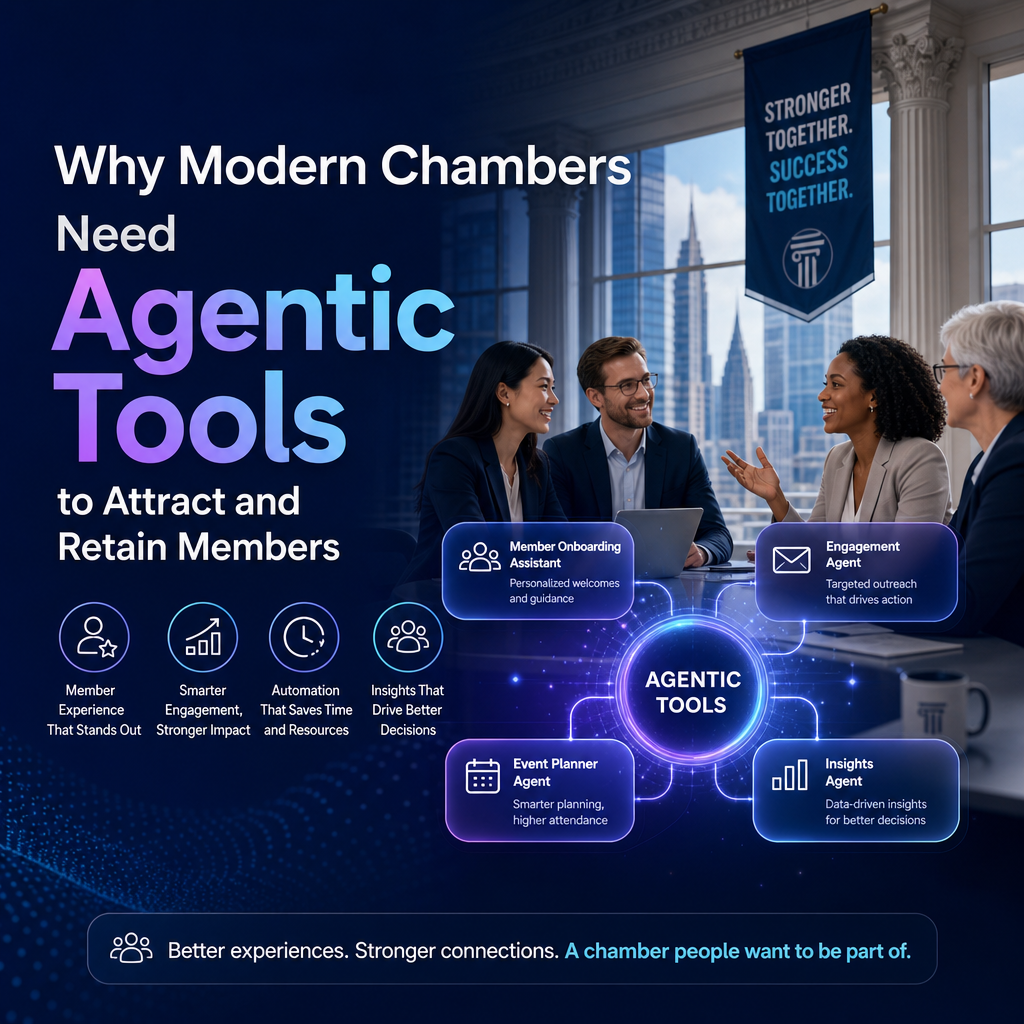
Why Modern Chambers Need Agentic Tools to Attract and Retain Members
Why Modern Chambers Need Agentic Tools to Attract and Retain Members
Chambers of commerce are no longer judged only by the events they host or the newsletters they send. Today’s members expect faster service, more personalized support, and clear proof that their membership delivers value. That is why modern chambers need agentic tools to stay competitive.
Agentic tools do more than automate routine tasks. They can act, decide, prioritize, and respond in ways that help chambers engage members more effectively. For organizations that rely on trust, relationships, and community value, this shift is becoming essential.
What Makes a Chamber “Modern” Today?
A modern chamber is not just a local business network. It is a strategic hub that connects members to opportunities, information, and each other.

Members now expect:
- Instant answers to common questions
- Relevant event and program recommendations
- Faster onboarding and support
- More consistent communication
- Clear ROI from their membership
Traditional processes can struggle to keep up. Staff teams are often small, and administrative work can consume the time that should be spent on relationship-building. Agentic tools help chambers bridge that gap.
What Are Agentic Tools?
Agentic tools are AI-powered systems that can take initiative based on goals, context, and rules. Instead of waiting for a person to manually trigger every action, they can help manage workflows and respond intelligently.
For chambers, that might include:
- Recommending the right events to the right members
- Following up with new members after sign-up
- Identifying at-risk members before they disengage
- Drafting personalized outreach messages
- Routing member requests to the right staff member
In other words, these tools help chambers act more like a responsive service organization and less like a static membership directory.
Why Attracting Members Is Harder Than Before
Attracting new members has always been important, but it is now more competitive. Businesses have many options for networking, marketing, and community support. If a chamber cannot clearly show value early, prospects may not join.
Agentic tools can improve member acquisition by helping chambers:
Personalize outreach
Instead of sending the same message to every prospect, chambers can tailor communications based on industry, business size, location, or stated interests.
Speed up responses
When a prospect submits a form or asks a question, quick follow-up matters. Agentic systems can ensure no lead goes unanswered.
Improve onboarding
A smooth first experience increases the chance that new members stay engaged. Automated but personalized onboarding journeys help people quickly understand benefits, events, and opportunities.
These improvements do not replace human connection. They make it easier to create it.
Why Retention Matters Even More
Getting a member to join is only the first step. Retention is where long-term chamber health is built. If members do not feel seen, supported, and connected, they may leave quietly.
That is where agentic tools become especially valuable.
They help chambers spot disengagement early
A member who stops opening emails, attending events, or logging into a portal may be losing interest. Agentic tools can flag these patterns so staff can reach out before renewal time.
They keep communication relevant
Not every member needs the same updates. A small retailer, a nonprofit, and a manufacturing company have different priorities. Agentic systems can segment audiences and deliver content that feels useful rather than generic.
They reduce friction
When members can quickly find answers, register for events, or discover resources, they are more likely to keep participating. Convenience supports loyalty.
How Agentic Tools Free Up Chamber Staff
One of the biggest advantages of agentic tools is that they save time without sacrificing service. Chamber teams often do a lot with limited resources. Manual follow-ups, data entry, member tracking, and event coordination can take over the workday.
By handling repetitive tasks, agentic tools allow staff to focus on the parts of the job that require human judgment:
- Building relationships
- Hosting meaningful conversations
- Developing partnerships
- Supporting high-value members
- Strengthening the chamber’s local reputation
This balance is important. Members still want real people. They just do not want to wait for them to handle every basic request.
Building a Better Member Experience
The best chambers are those that make members feel like active participants, not just names on a spreadsheet. Agentic tools help create that experience by making every interaction more timely and relevant.
A strong member journey may include:
- A personalized welcome after joining
- Suggested events based on business interests
- Automatic reminders and follow-ups
- Targeted renewal communication
- Proactive outreach when engagement drops
Each step strengthens the relationship and increases the likelihood of long-term membership.
The Future of Chamber Growth
Chambers that embrace agentic tools are better positioned to grow in a changing environment. They can respond faster, communicate better, and serve members with more consistency. Most importantly, they can prove that membership is not just a fee—it is an experience.
As expectations continue to rise, modern chambers need agentic tools to remain relevant, efficient, and member-centered. The chambers that adapt will not only attract more members. They will keep them engaged for the long term.
Conclusion
Member attraction and retention are no longer driven by tradition alone. They depend on responsiveness, personalization, and consistent value. Agentic tools give chambers the ability to deliver all three at scale.
For chambers looking to deepen relationships and strengthen their future, adopting these tools is not just a technology upgrade. It is a strategic move toward better service, stronger loyalty, and sustainable growth.